
Supine Mini-PCNL for Kidney Stones
A minimally invasive approach to selected kidney stones using a small access tract while the patient remains in a supine (lying on the back) position.
Learn when Supine Mini-PCNL may be considered and how it compares with other kidney stone treatment options.
At a Glance
- Supine Mini-PCNL is a minimally invasive treatment for selected kidney stones.
- The procedure is performed with the patient lying on their back (supine position).
- Compared with conventional PCNL, it uses a smaller access tract and may be suitable for selected stones.
What Is Supine Mini-PCNL?
Percutaneous nephrolithotomy (PCNL) is a well-established treatment for large or complex kidney stones.
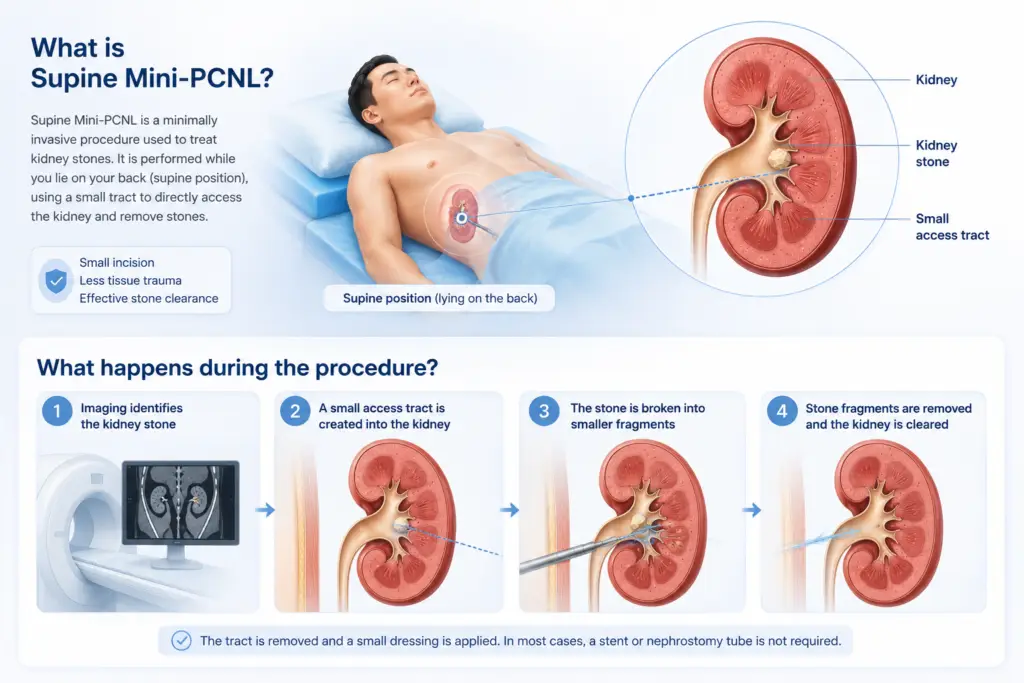
Traditionally, PCNL is performed with the patient lying face down (prone position). In Supine Mini-PCNL, the procedure is performed while the patient lies on their back with specific positioning adjustments that allow safe access to the kidney.
A small skin incision is made, and a narrow tract is created into the kidney. Special miniature instruments are then used to break and remove the stone fragments.
The term:
- Supine refers to the patient lying on their back
- Mini-PCNL refers to the use of smaller access instruments than conventional PCNL
When Might Supine Mini-PCNL Be Recommended?
The most appropriate treatment depends on the stone characteristics and findings from imaging studies such as CT scans.
Supine Mini-PCNL may be considered for:
- Larger kidney stones
- Stones that are unlikely to pass naturally
- Stones causing pain, infection, or blockage
- Stones that are not suitable for ESWL
- Stones that may be difficult to treat with ureteroscopy alone
- Selected complex kidney stones
How Does Supine Mini-PCNL Compare With Other Kidney Stone Treatments?
Several treatment options are available for kidney stones. The most appropriate approach depends on the size, location, and complexity of the stone, as well as individual patient factors.
| Treatment | Typical Role | Access Route |
|---|---|---|
| ESWL | Smaller stones suitable for shockwave treatment | No incision |
| URS / RIRS | Stones in the ureter or kidney treated through natural urinary passages | Through the urethra |
| Mini-PCNL | Larger or more complex kidney stones requiring direct access | Small incision into the kidney |
| Standard PCNL | Very large or complex stone burdens | Larger access tract into the kidney |
No single stone treatment is best for every situation. Factors such as stone size, stone location, stone density, kidney anatomy, previous treatment history, and overall health help determine which option is most appropriate.
How Does It Differ From Standard PCNL?
| Feature | Supine Mini-PCNL | Standard PCNL |
|---|---|---|
| Patient position | Lying on the back | Lying face down |
| Access tract | Smaller | Larger |
| Instruments | Miniaturised | Standard-sized |
| Suitable for | Selected stones | Larger and more complex stones |
| Goal | Stone clearance with minimally invasive access | Stone clearance for larger stone burdens |
Both techniques remain valuable treatment options and are chosen according to the clinical situation.
Choosing Between Mini-PCNL and Standard PCNL
Mini-PCNL and standard PCNL are not competing procedures. Each has a role in modern stone surgery. The choice depends on factors such as stone size, complexity, kidney anatomy, and the likelihood of achieving stone clearance in a single procedure.
Potential Advantages of the Supine Position
The supine approach has become increasingly popular in selected centres worldwide.
Potential advantages may include:
- Easier airway access for the anaesthesia team
- No need to reposition the patient after anaesthesia
- Possibility of combining ureteroscopy and PCNL during the same procedure when appropriate
- Improved operating room efficiency in selected cases
- Greater comfort for some patients with certain medical conditions
These advantages may not apply to every patient, and the choice of position is individualised. These potential advantages relate primarily to the surgical approach and operating room workflow rather than stone clearance itself.
What Happens During the Procedure?
The procedure is performed under general anaesthesia. The infographic below provides a simplified overview of the main steps involved in Supine Mini-PCNL.
Recovery After Supine Mini-PCNL
Most patients remain in hospital for a short period after surgery.
Recovery commonly involves:
- Mild discomfort around the access site
- Temporary blood staining of the urine
- Gradual return to normal activities
- Follow-up imaging to assess stone clearance
Recovery times vary according to the complexity of the procedure and the size of the stone treated.
Are There Risks?
As with any surgical procedure, complications can occur.
Potential risks include:
- Bleeding
- Infection
- Injury to surrounding structures
- Residual stone fragments
- Need for additional procedures
- Temporary urinary drainage tubes or stents
Your urologist will discuss the expected benefits and potential risks in relation to your individual case.
When Should You Discuss Supine Mini-PCNL With a Urologist?
A discussion with a urologist may be appropriate if you have:
- A large kidney stone
- Recurrent stone episodes
- Stones causing obstruction or infection
- Stones that have not responded to previous treatment
- Complex kidney stone disease requiring definitive treatment
Imaging studies and an individual assessment are needed to determine whether Supine Mini-PCNL is an appropriate option.
Frequently Asked Questions
Why might a surgeon choose the supine position instead of the traditional prone position?
The supine position allows the procedure to be performed while the patient lies on their back. In selected situations, this may improve operating room workflow, facilitate anaesthetic management, or allow combined procedures to be performed during the same operation. The choice depends on the stone, anatomy, and surgical preference.
Can both kidneys be treated during the same operation?
In selected cases, treatment of stones on both sides may be considered. Whether this is appropriate depends on the stone burden, anticipated operating time, and overall patient health.
Will stone fragments be sent for analysis?
Stone analysis is often recommended after stone surgery. Identifying the stone composition can help guide dietary advice, metabolic evaluation, and strategies to reduce the risk of future stone formation.
How soon can I travel after Supine Mini-PCNL?
Travel recommendations vary depending on recovery, the presence of a ureteric stent, and the complexity of the procedure. Many people can resume routine travel within a short period, but long-distance travel should be discussed with the treating team.
Does Supine Mini-PCNL affect future kidney stone treatments?
No. If new stones develop in the future, other treatment options such as ESWL, ureteroscopy, RIRS, or repeat PCNL may still be considered depending on the circumstances.
How is Supine Mini-PCNL different from Mini-PCNL?
“Mini-PCNL” refers to the use of a smaller access tract into the kidney. “Supine Mini-PCNL” refers specifically to performing Mini-PCNL while the patient lies on their back. Mini-PCNL can also be performed in other positions.
Will I need follow-up after the procedure even if the stone has been removed?
Yes. Follow-up may include imaging, review of stone analysis results, and assessment for factors that increase the risk of recurrent stone formation. Preventing future stones is an important part of long-term care.