
Ureteroscopy (URS) for Kidney and Ureteric Stones
Ureteroscopy (URS) is a minimally invasive procedure used to treat kidney and ureteric stones using a small telescope passed through the natural urinary passage.
Learn how ureteroscopy is performed, when it may be recommended, and what recovery typically involves.
What Is Ureteroscopy?
Ureteroscopy (URS) is a procedure that allows a urologist to examine and treat stones located within the ureter or kidney.
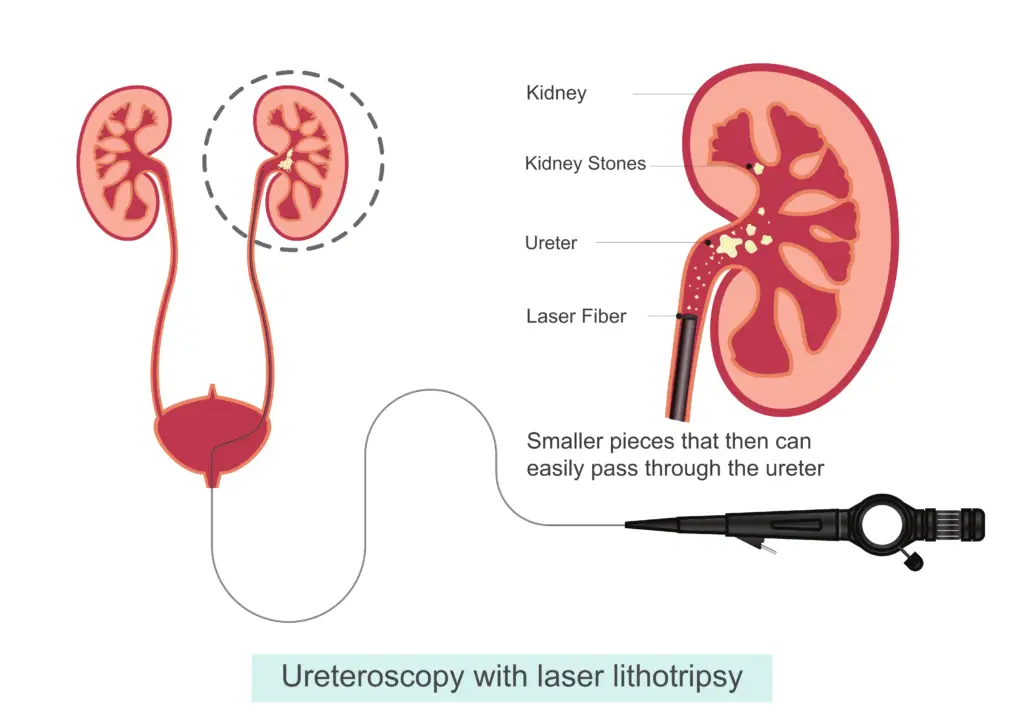
A thin telescope called a ureteroscope is passed through the urethra, bladder, and ureter without the need for external incisions.
Special instruments may be used to remove the stone directly or to fragment it into smaller pieces using laser technology.
At a Glance
Ureteroscopy (URS)
- Minimally invasive treatment for kidney and ureteric stones
- No external surgical incision required
- Performed through the natural urinary passage
- Usually carried out under general anaesthesia
- May involve laser stone fragmentation
- Temporary ureteric stenting may sometimes be required
- Most patients return home the same day
When Might Ureteroscopy Be Recommended?
Ureteroscopy may be considered when:
- A stone is unlikely to pass naturally
- ESWL is unsuitable or unsuccessful
- A stone is causing pain or obstruction
- Stone removal is required more promptly
- The stone’s size or location makes ureteroscopy a suitable option
The most appropriate treatment depends on the size, location, composition, and complexity of the stone, as well as individual patient factors.
How Is Ureteroscopy Performed?
During the procedure:
- A ureteroscope is passed through the urinary passage into the ureter.
- The stone is visualised using a small ureteroscope.
- A laser may be used to fragment the stone.
- Stone fragments may be removed using specialised retrieval devices or left to pass naturally.
- A temporary ureteric stent may be placed if needed.
No external incision is usually required.
Is Laser Treatment Always Used?
Laser technology is commonly used during ureteroscopy to break stones into smaller fragments.
The decision depends on factors such as:
- Stone size
- Stone hardness
- Stone location
- Treatment objectives
In some cases, small stones may be removed without extensive fragmentation.
Will I Need a Ureteric Stent Afterwards?
Not every patient requires a stent.
However, temporary stenting may be recommended if:
- The ureter is swollen
- Multiple stones are treated
- Larger stones are fragmented
- Additional drainage support is required
The decision is individualised based on findings during treatment.
Recovery After Ureteroscopy
Most patients return home on the same day or after a short hospital stay.
Temporary symptoms may include:
- Mild discomfort during urination
- Increased urinary frequency
- Small amounts of blood in the urine
- Temporary stent-related symptoms if a stent is present
Recovery experiences vary between individuals.
Possible Risks and Complications
Although ureteroscopy is commonly performed and generally well tolerated, all procedures carry potential risks.
Possible complications may include:
- Urinary tract infection
- Blood in the urine for a short period
- Temporary discomfort from a ureteric stent
- Incomplete stone clearance requiring further treatment
- Injury to the ureter (uncommon)
- Need for additional procedures in selected cases
Ureteroscopy Compared With Other Stone Treatments
| Treatment | Typical Role |
|---|---|
| Observation | Small stones likely to pass naturally |
| ESWL | Selected kidney and ureteric stones |
| Ureteroscopy (URS) | Direct treatment of ureteric and selected kidney stones |
| RIRS | Stones located within the kidney |
| PCNL | Larger or complex kidney stones |
Each approach has advantages and limitations, and treatment selection depends on individual circumstances.
Which Kidney Stone Treatment Is Right for You?
The most appropriate treatment depends on factors such as:
- Stone size
- Stone location
- Symptoms
- Stone composition
- Previous stone history
- Overall health
Understanding the differences between observation, ESWL, ureteroscopy (URS), RIRS, and PCNL can help patients make informed decisions about treatment.
Appointments with Dr Roger Anthony Idi are arranged through Prince Court Medical Centre.
Frequently Asked Questions
Is ureteroscopy painful?
Ureteroscopy is usually performed under general anaesthesia, so patients are asleep during the procedure. Afterwards, some temporary discomfort during urination, urinary frequency, or mild flank discomfort may occur, particularly if a ureteric stent has been placed.
How successful is ureteroscopy for kidney stones?
Success depends on factors such as the size, location, and complexity of the stone. Many stones can be treated effectively with ureteroscopy, although some patients may require additional procedures if residual fragments remain.
Will I need a ureteric stent after ureteroscopy?
Not always. A stent may be recommended to support urine drainage, reduce the risk of obstruction from swelling, or assist healing after treatment. The decision is based on findings during the procedure.
How long does recovery usually take?
Many people resume light daily activities within a few days. Recovery varies depending on the complexity of treatment, whether a stent is present, and individual factors.
Can kidney stones come back after ureteroscopy?
Yes. Ureteroscopy removes existing stones but does not prevent new stones from forming. Depending on the type of stone and individual risk factors, ongoing prevention strategies may be recommended.