
Nephrostomy Tube:
What Patients Should Know
Understanding why a nephrostomy tube may be needed, how it drains the kidney, and what to expect during treatment and recovery.
A nephrostomy tube drains urine directly from the kidney when normal urinary flow is blocked. It may be used to relieve pressure, manage infection, protect kidney function, or provide temporary drainage before further treatment.
At A Glance
Nephrostomy Tube
- Drains urine directly from the kidney
- Usually inserted through the skin of the back
- Commonly used when urine cannot drain normally
- May be required for kidney stones, infection, ureteric obstruction, or cancer-related blockage
- Helps relieve pressure within the kidney
- Can protect kidney function during periods of obstruction
- Often serves as a temporary solution before definitive treatment
- Requires ongoing tube care and follow-up
On This Page
UNDERSTANDING THE CONDITION
TREATMENT AND DRAINAGE OPTIONS
PROCEDURE AND RECOVERY
FOLLOW-UP AND SAFETY
FREQUENTLY ASKED QUESTIONS
Why Might A Nephrostomy Tube Be Needed?
The kidneys continuously produce urine.
Normally, urine flows from the kidneys into the ureters, then into the bladder before being passed from the body.
When this pathway becomes blocked, urine may begin to accumulate within the kidney.
In some situations, restoring drainage becomes the immediate priority.
A nephrostomy tube provides an alternative route for urine to leave the kidney when normal drainage is no longer possible or no longer safe.
Why Can A Blocked Kidney Become Serious?
Many people associate urinary obstruction primarily with pain.
However, prolonged obstruction can affect kidney function and, in some situations, become a medical emergency.
When urine remains trapped within the kidney, pressure gradually builds within the collecting system.
This may result in:
- Hydronephrosis (swelling of the kidney)
- Deterioration in kidney function
- Persistent pain
- Infection
- Sepsis in severe cases
For this reason, restoring drainage may sometimes take priority over treating the underlying cause immediately.
Why Is Infection With Obstruction Treated Urgently?
An infected obstructed kidney is one of the most important situations in which emergency drainage may be required.
When bacteria become trapped behind an obstruction, infection can become difficult to control because urine is unable to drain normally.
In this situation, antibiotics alone may not be sufficient.
Restoring drainage allows infected urine to leave the kidney and may be an important part of treatment.
This is one reason some patients undergo nephrostomy insertion before any attempt is made to remove a kidney stone.
Is A Nephrostomy Tube A Treatment For Kidney Stones?
Not usually.
A nephrostomy tube often addresses the consequence of a stone rather than the stone itself.
Its role is to drain the kidney and relieve obstruction.
The stone may still require treatment later using procedures such as:
- Ureteroscopy (URS)
- Retrograde Intrarenal Surgery (RIRS)
- Percutaneous Nephrolithotomy (PCNL)
- Other stone treatments where appropriate
This explains why a patient may be told that the kidney has been drained even though the stone remains present.
Why Might A Nephrostomy Tube Be Chosen Instead Of A Ureteric Stent?
Both a nephrostomy tube and a ureteric stent are designed to restore urine drainage from the kidney.
However, they achieve this in different ways.
A ureteric stent drains urine internally by bridging the blockage and allowing urine to flow from the kidney into the bladder.
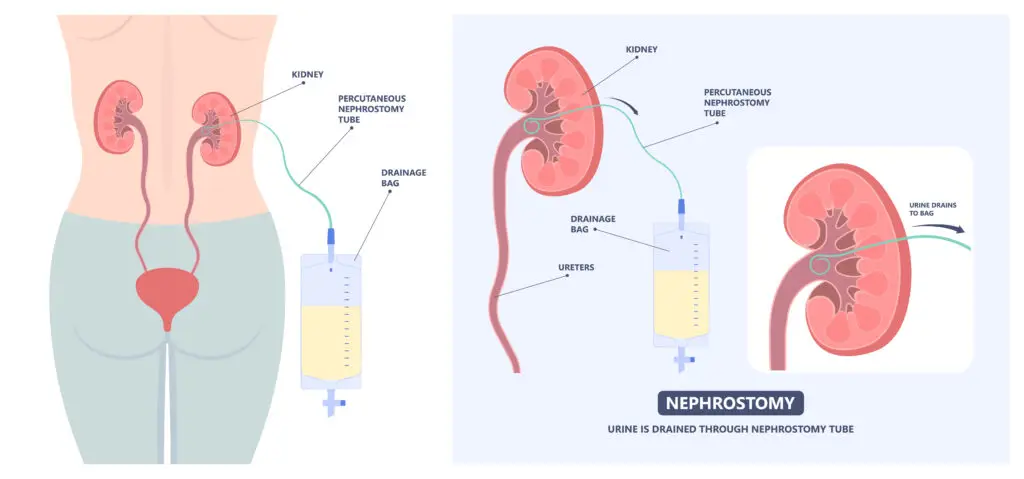
A nephrostomy tube drains urine externally through the back into a collection bag.
The choice depends on the clinical situation rather than one option being universally better than the other.
| Feature | Nephrostomy Tube | Ureteric Stent |
|---|---|---|
| How urine drains | Urine drains externally into a collection bag | Urine drains internally from the kidney to the bladder |
| Visible outside the body | Yes | No |
| Main purpose | Direct drainage of the kidney when urine cannot drain normally | Internal drainage across a blockage within the ureter |
| May be used in urgent obstruction | Yes | Yes, in selected situations |
| How it is usually inserted | Through the skin of the back using imaging guidance (often under local anaesthetic with sedation) | Via the bladder and ureter using a telescope (usually under regional or general anaesthesia) |
Can A Nephrostomy Tube Be Converted To A Stent Later?
Sometimes.
Once infection has settled or the underlying obstruction has been assessed, some patients may later undergo ureteric stent placement.
This allows urine to drain internally and may remove the need for an external drainage bag.
The most appropriate approach depends on the cause of obstruction, kidney drainage, and future treatment plans.
How Is A Nephrostomy Tube Inserted?
Nephrostomy insertion is usually performed using imaging guidance.
Ultrasound, X-ray guidance, or a combination of imaging techniques may be used to identify the collecting system and guide tube placement.
Once the tube has been positioned, urine drains externally into a collection bag.
The procedure is commonly performed by an interventional radiologist.
What Happens Immediately After Insertion?
Many patients notice that urine begins draining into the collection bag shortly after the tube is placed.
In situations where the kidney has been obstructed for some time, urine output may initially be higher than expected as pressure within the kidney is relieved.
The appearance of the urine may vary.
Blood-stained urine is not uncommon immediately after insertion and often improves with time.
Living With A Nephrostomy Tube
One of the most common concerns is how daily activities will be affected.
Many patients are able to:
- Walk normally
- Travel short distances
- Carry out light activities
- Sleep comfortably
- Leave hospital once medically stable
The drainage bag is usually secured beneath clothing and emptied regularly.
Patients are generally provided with instructions regarding dressing care, tube care, and when to seek medical attention.
Why Might The Tube Need To Stay In Place For Weeks Or Months?
The duration depends on the reason it was inserted.
For example:
| Underlying Problem | Why A Nephrostomy May Be Needed |
|---|---|
| Obstructing kidney stone | To restore urine drainage and protect the kidney until the stone can be treated |
| Infection behind a blockage | To allow infected urine to drain when antibiotics alone may not be sufficient |
| Ureteric stricture disease | To bypass the obstruction and maintain kidney drainage |
| Cancer-related ureteric obstruction | To preserve kidney function and relieve urinary obstruction |
The tube is therefore often part of a broader treatment pathway rather than the final treatment itself.
What Problems Should Prompt Medical Review?
Contact Your Healthcare Team If You Notice:
✓ Fever or chills
✓ Increasing pain
✓ Little or no urine draining
✓ Tube accidentally pulled out
✓ Significant leakage around the tube
✓ Increasing redness or swelling
Can A Nephrostomy Tube Be Removed?
Removal is usually considered once urine can drain adequately through the normal urinary tract or another drainage solution has been established.
Examples include:
- Successful stone treatment
- Resolution of infection
- Placement of a ureteric stent
- Definitive treatment of the obstruction
Before removal, assessment is often performed to ensure that kidney drainage remains satisfactory.
Frequently Asked Questions
Does having a nephrostomy tube mean my kidney is failing?
Not necessarily. In many situations, the tube is inserted specifically to protect kidney function by restoring drainage before permanent damage occurs.
Will urine still pass normally if I have a nephrostomy tube?
Sometimes. Depending on the underlying condition, some urine may continue to pass through the bladder while some drains through the nephrostomy tube.
Why does urine drain into a bag instead of the bladder?
The purpose of the nephrostomy tube is to bypass the obstruction completely. Draining urine externally allows pressure within the kidney to be relieved immediately.
Can a nephrostomy tube be used for kidney stones?
Yes, but usually as a drainage procedure rather than a stone treatment. The tube relieves obstruction while definitive stone treatment is planned.
Can I shower with a nephrostomy tube?
Many patients can shower after receiving appropriate instructions regarding dressing protection and tube care.
Can I travel with a nephrostomy tube?
Many patients can travel and carry out normal daily activities once they have recovered and understand how to manage the drainage system.
Is blood in the nephrostomy bag normal?
A small amount of blood-stained urine may occur after insertion. However, persistent heavy bleeding or a sudden change should be reviewed by a healthcare professional.
What is the difference between a nephrostomy tube and a ureteric stent?
A nephrostomy tube drains urine externally through the back into a collection bag. A ureteric stent drains urine internally from the kidney to the bladder.
Need Further Assessment?
A nephrostomy tube is often part of a broader treatment pathway rather than the final treatment itself.
The underlying cause of the obstruction, such as a kidney stone, ureteric stricture, infection, or other condition, usually requires further assessment and management.
Appointments with Dr Roger Anthony Idi are arranged through Prince Court Medical Centre.