
RIRS (Retrograde Intrarenal Surgery) for Kidney Stones
A minimally invasive treatment that allows stones within the kidney to be reached and treated through the natural urinary passage, without an external incision.
RIRS allows a urologist to reach stones located within the kidney using a flexible telescope passed through the urinary tract. It is commonly used for selected kidney stones that are unlikely to pass naturally or are unsuitable for shock wave treatment.
What Is RIRS?
Retrograde Intrarenal Surgery (RIRS) is a minimally invasive procedure used to treat kidney stones without making an incision through the skin.
Retrograde Intrarenal Surgery (RIRS) is a minimally invasive procedure used to treat kidney stones without making an incision through the skin.
Why Might RIRS Be Recommended?
Not all kidney stones require the same treatment. The most suitable approach depends largely on where the stone is located, its size, and how likely it is to cause symptoms or complications.
Some stones may pass naturally. Others can be treated with shock wave therapy (ESWL), while larger stones may require procedures such as percutaneous nephrolithotomy (PCNL).
RIRS provides a way of directly reaching and treating stones within the kidney. It is commonly used when a stone is unlikely to pass, when shock wave treatment is unsuitable, or when direct visualisation of the stone is advantageous.
One advantage of RIRS is that the flexible scope can access areas of the kidney that may be difficult to treat with some other minimally invasive approaches.
At a Glance
RIRS
- Minimally invasive treatment for kidney stones
- No incision through the skin
- Flexible scope passed through the natural urinary tract
- Often combined with laser stone fragmentation
- Usually performed under general anaesthesia
- Commonly performed as a day procedure
- A temporary ureteric stent may sometimes be required
How Does RIRS Reach the Kidney?
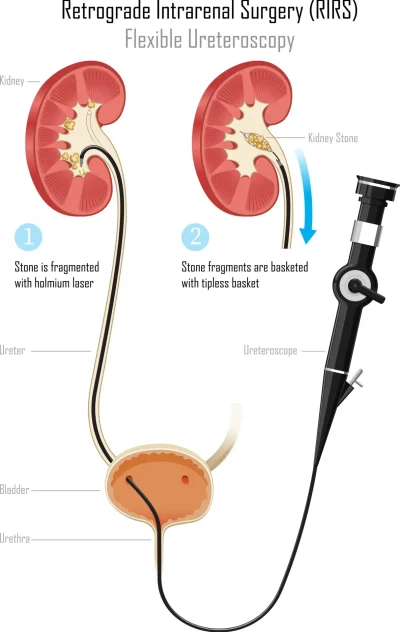
RIRS is performed through the natural urinary tract.
A flexible ureteroscope is passed through:
- The urethra
- The bladder
- The ureter
- Into the kidney
Once the stone has been reached, it can be assessed and treated under direct vision.
Laser energy is commonly used to fragment the stone into smaller pieces. Depending on the situation, fragments may be removed during the procedure or left to pass naturally afterwards.
When Might RIRS Be Considered?
RIRS may be considered when:
- A stone is located within the kidney
- A stone is unlikely to pass naturally
- ESWL is unsuitable or unsuccessful
- The stone can be accessed effectively using a flexible ureteroscope
- Stone-related symptoms are persistent
- Obstruction, recurrent infection, or stone growth are concerns
The choice between RIRS and other stone treatments depends on the characteristics of the stone and the goals of treatment.
How Does RIRS Compare With Other Kidney Stone Treatments?
Kidney stone treatments differ in how the stone is reached and treated.
Some treatments act from outside the body, while others allow the stone to be visualised directly using endoscopic instruments.
RIRS occupies a position between ESWL and PCNL. It provides direct access to stones within the kidney without requiring an incision through the skin.
| Treatment | Typical Role |
|---|---|
| Observation | Monitoring stones that may pass naturally |
| ESWL | Fragmenting selected stones using shock waves |
| Ureteroscopy (URS) | Direct treatment of ureteric and selected kidney stones |
| RIRS | Endoscopic treatment of stones located within the kidney |
| PCNL | Treatment of larger or more complex kidney stones |
RIRS vs Ureteroscopy (URS): What's the Difference?
RIRS and ureteroscopy (URS) use similar equipment and techniques.
Both procedures involve passing endoscopic instruments through the urinary tract and may involve laser stone fragmentation.
The main difference is the location of the stone being treated.
| Procedure | Main Treatment Area |
|---|---|
| URS | Primarily ureteric stones |
| RIRS | Stones located within the kidney |
In practice, the distinction is not always absolute. Because the ureter and kidney are connected, some procedures may involve treatment of stones in both locations during the same operation.
Will All Stone Fragments Be Removed?
The goal of treatment is to achieve the highest possible degree of stone clearance.
Whether every fragment is removed depends on factors such as stone size, location, visibility, and procedural considerations.
Very small residual fragments may sometimes be observed rather than actively removed if they are unlikely to cause symptoms or future problems.
Follow-up imaging is often used to assess stone clearance after treatment.
Will I Need a Ureteric Stent Afterwards?
A temporary ureteric stent may be inserted following RIRS.
A stent can help maintain urine drainage, reduce the risk of obstruction from swelling, facilitate passage of small fragments, and support healing of the urinary tract.
Not every patient requires a stent, and the decision is usually made during the procedure based on the findings.
Recovery After RIRS
Most patients return home on the same day or after a short hospital stay. Recovery is generally quicker than procedures that require an incision through the skin.
Temporary symptoms may include:
- Mild discomfort during urination
- Increased urinary frequency
- Small amounts of blood in the urine
- Temporary stent-related symptoms if a stent has been inserted
The recovery experience is influenced by factors such as stone burden, treatment complexity, and whether a temporary stent has been inserted.
Possible Risks and Complications
RIRS is widely performed and is generally considered safe, but no procedure is entirely without risk.
Possible complications may include:
- Urinary tract infection
- Temporary bleeding in the urine
- Discomfort related to a ureteric stent
- Residual stone fragments
- Injury to the ureter
- Need for additional procedures
The likelihood of complications depends on factors such as stone size, location, anatomy, and procedural complexity.
Frequently Asked Questions
Is RIRS painful?
RIRS is usually performed under general anaesthesia. Afterwards, temporary urinary discomfort, increased frequency, or stent-related symptoms may occur during recovery.
How successful is RIRS?
Success depends on factors such as stone size, location, and complexity. Many kidney stones can be treated effectively with RIRS, although additional procedures may occasionally be required.
Will I need a stent afterwards?
Not always. A temporary ureteric stent may be recommended to support drainage and healing following treatment.
How long does recovery usually take?
Many people return to normal daily activities within a few days, although recovery varies according to the complexity of treatment and whether a stent has been inserted.
Can kidney stones return after RIRS?
Yes. RIRS treats existing stones but does not prevent new stones from forming. Depending on the stone type and individual risk factors, further evaluation and prevention strategies may be recommended.
Understanding Your Treatment Options
RIRS is one of several procedures used to treat kidney stones. Other options may include observation, shock wave therapy (ESWL), ureteroscopy (URS), or percutaneous nephrolithotomy (PCNL), depending on the size and location of the stone.
Understanding the differences between these treatments can help patients discuss the advantages, limitations, and expected outcomes of each approach.
Appointments with Dr Roger Anthony Idi are arranged through Prince Court Medical Centre.