
Urodynamic Testing for Bladder and Urinary Symptoms
Urodynamic testing helps assess how the bladder fills, stores, and empties urine.
It may be recommended when symptoms such as urinary leakage, urgency, frequent urination, poor flow, or incomplete emptying need further evaluation.
This test provides information about bladder pressure, urine flow, and bladder muscle function, helping guide more appropriate treatment decisions.
What Is Urodynamic Testing?
Urodynamic testing, also called urodynamics, is a group of tests used to study how the bladder and urethra work during urine storage and urination.
It can help assess:
- How much urine the bladder can hold
- Whether the bladder contracts too early or too strongly
- Whether the bladder muscle is weak
- Whether urine flow is blocked
- Whether the bladder empties properly
- How the bladder and sphincter muscles coordinate
Urodynamic testing is not needed for every urinary symptom. It is usually considered when symptoms are persistent, complex, unclear, or when treatment decisions depend on understanding bladder function more precisely.
When Is Urodynamic Testing Helpful?
Most urinary symptoms can be assessed using a medical history, examination, urine tests, bladder scans, and urine flow studies.
However, some symptoms remain difficult to explain or may have more than one possible cause. In these situations, urodynamic testing can provide additional information about how the bladder stores and passes urine.
Urodynamic testing may be considered for:
- Urinary leakage or incontinence
- Sudden urgency to urinate
- Frequent urination
- Difficulty starting urination
- Weak or interrupted urine flow
- Feeling that the bladder does not empty completely
- Recurrent urinary tract infections associated with poor bladder emptying
- Symptoms following previous prostate, bladder, or pelvic surgery
- Suspected nerve-related bladder dysfunction
- Assessment before selected continence or reconstructive procedures
Many urinary symptoms can appear similar but arise from different underlying problems. For example, a weak urine stream may result from bladder outlet obstruction, a weak bladder muscle, or a combination of both. Urodynamic testing helps distinguish between these possibilities and can assist with treatment planning.
What Happens During Urodynamic Testing?
The exact test may vary depending on the symptoms being investigated.
Urodynamic testing may include several different measurements. The exact tests performed depend on the symptoms being investigated.
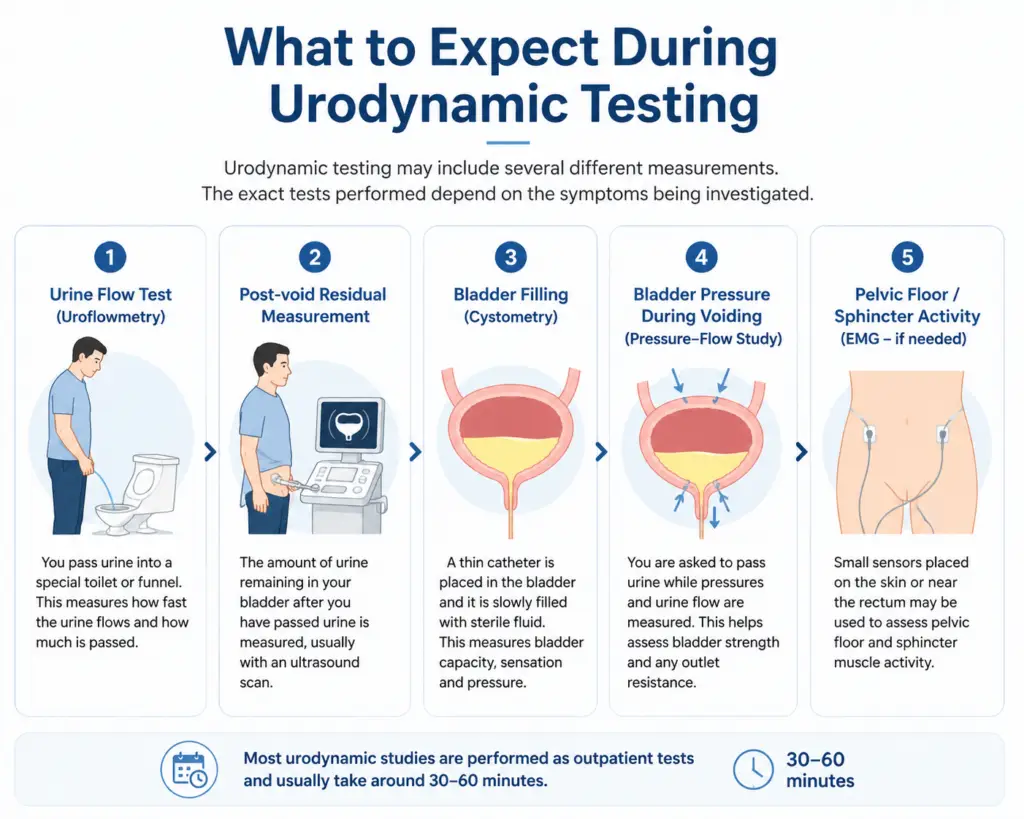
Common parts of urodynamic testing include:
1. Uroflowmetry
You pass urine into a special toilet or flow machine. This measures how fast urine flows and how much urine is passed.
It helps show whether the urine stream is normal, slow, interrupted, or suggestive of obstruction or weak bladder contraction.
2. Post-Void Residual Measurement
After urination, the amount of urine left in the bladder is measured. This may be done using ultrasound or a small catheter.
A high residual urine volume may suggest incomplete bladder emptying.
3. Cystometry
A thin catheter is gently inserted into the bladder. The bladder is slowly filled with sterile fluid while pressure is measured.
This assesses bladder capacity, sensation, pressure changes, and whether the bladder contracts unexpectedly.
4. Pressure-Flow Study
This part measures bladder pressure while urine is passed.
It helps distinguish between bladder outlet obstruction and a weak bladder muscle, which can produce similar symptoms but may need different treatment.
5. Pelvic Floor or Sphincter Assessment
Small surface sensors may be used in some cases to assess pelvic floor or sphincter muscle activity.
This can help identify coordination problems during urination.
Is Urodynamic Testing Painful?
Most patients tolerate urodynamic testing well.
The most uncomfortable part is usually insertion of the small catheter. Local anaesthetic gel may be used to reduce discomfort.
During bladder filling, you may feel the urge to pass urine. This is expected and helps the doctor understand how your bladder behaves.
Some patients may notice mild burning when passing urine after the test. This usually settles within a short time.
Is Urodynamic Testing Safe?
Urodynamic testing is generally considered a safe outpatient procedure.
Possible temporary side effects include:
- Mild discomfort during catheter insertion
- Burning when passing urine for a short time
- Passing urine more frequently for a short period
- Small amount of blood in the urine
- Urinary tract infection, uncommon but possible
You should seek medical advice if you develop fever, worsening pain, difficulty passing urine, or symptoms of infection after the test.
How Should I Prepare?
Preparation instructions may vary depending on the clinic and reason for testing.
You may be asked to:
- Arrive with a comfortably full bladder
- Bring a list of your medications
- Inform the doctor if you are taking blood thinners
- Tell the clinic if you have symptoms of a urinary tract infection
- Bring previous test results, bladder diaries, scans, or urine flow reports if available
Some bladder medications may need to be paused before the test, but this should only be done if advised by the doctor.
What Happens After the Test?
Most people can go home shortly after urodynamic testing.
You can usually return to normal activities the same day, unless advised otherwise.
Drinking water after the test may help reduce mild urinary discomfort. If symptoms persist or worsen, the clinic should be contacted.
The results are reviewed together with your symptoms, examination findings, urine tests, scans, and previous treatments. Urodynamic results are not interpreted in isolation.
What Conditions Can Urodynamic Testing Help Evaluate?
Urodynamic testing may help assess or support the diagnosis of:
- Overactive bladder
- Stress urinary incontinence
- Mixed urinary incontinence
- Bladder outlet obstruction
- Underactive bladder
- Incomplete bladder emptying
- Neurogenic bladder
- Poor bladder compliance
- Dysfunctional voiding
- Complex urinary symptoms after surgery
The test does not simply give a “normal” or “abnormal” answer. It provides functional information that helps guide treatment decisions.
Frequently Asked Questions
Is urodynamic testing the same as a urine flow test?
No. A urine flow test measures how fast urine comes out. Urodynamic testing gives more detailed information about bladder pressure, bladder capacity, sensation, and emptying.
Do I need urodynamic testing for overactive bladder?
Not always. Many patients with straightforward overactive bladder symptoms do not need urodynamics at the start. It may be considered if symptoms are complex, treatment has not worked, or the diagnosis is uncertain.
Can I drive after urodynamic testing?
Yes, most patients can drive and return to usual activities after the test.
Will I need antibiotics?
Not everyone needs antibiotics. The doctor will advise based on your risk factors, urine test results, and medical history.
Can urodynamic testing be done in older adults?
Yes. It is commonly used in older adults when bladder symptoms are complex or when treatment decisions require more detailed bladder function assessment.
How soon will I get the results?
Some findings may be discussed on the same day. In other cases, the results are reviewed together with your clinical history and discussed at a follow-up appointment.
Need Further Evaluation of Bladder Symptoms?
Urodynamic testing may be recommended when urinary symptoms remain persistent, complex, or difficult to explain after initial assessment.
A review with a urologist can help determine whether urodynamic testing is necessary, or whether other tests or treatments may be more appropriate first.
Appointments with Dr Roger Anthony Idi are arranged through Prince Court Medical Centre.